 Watchletic
Treadmill Running on Apple Watch with Watchletic
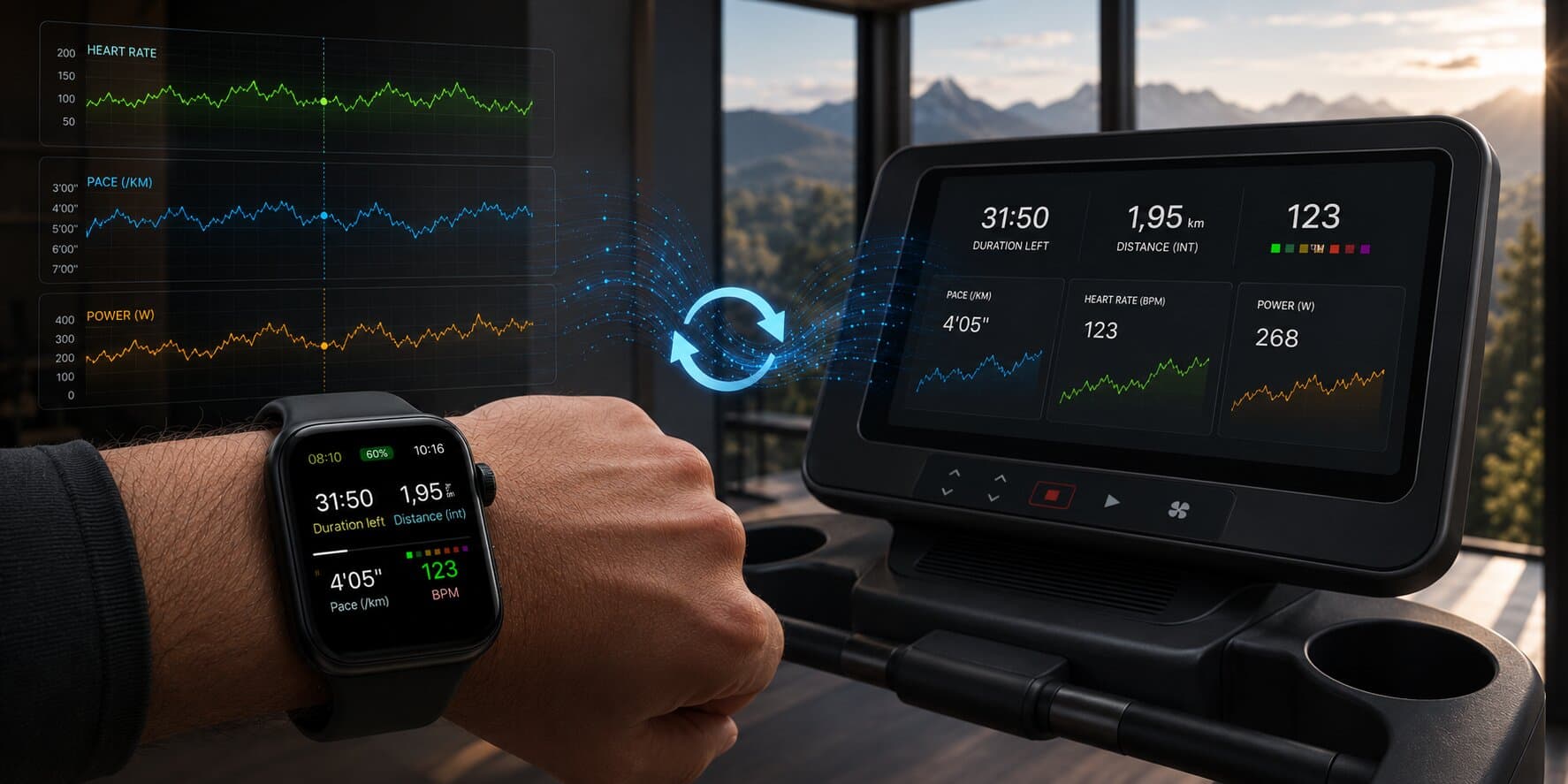
If you run indoors with an Apple Watch, you have probably noticed the problem: the watch is great at recording a workout, but treadmill pace and distance can still feel like an estimate.
That is because your wrist is not the treadmill belt. When you change speed, hold the rails, do intervals, or run on a treadmill that does not quite match its display, the Apple Watch has to infer what is happening from your movement.
Watchletic gives Apple Watch runners another option: connect directly to a compatible Bluetooth smart treadmill and use the treadmill itself as the source for indoor speed and distance.
Smart treadmill support in Watchletic
Watchletic supports compatible Bluetooth treadmills from the Apple Watch app. Once connected, Watchletic can use treadmill data during indoor running and indoor walking workouts.
When a treadmill is connected, Watchletic can record:
- speed
- distance
- incline
- treadmill-derived elevation
- cadence, when the treadmill provides it and Stryd is not connected
- stride length, when the treadmill provides it and Stryd is not connected
Watchletic can use those treadmill readings instead of relying only on wrist-based pace and distance estimates.
For structured workouts, this is especially useful. If you are running treadmill intervals, Watchletic can show your current pace or speed, track distance from the treadmill, and keep the workout inside the same Apple Watch workflow you already use for custom workouts, imports, exports, and Apple Health.
Runn
Watchletic also supports the NPE Runn Smart Treadmill Sensor.
Runn is useful when your treadmill is not a smart treadmill on its own. It attaches to your existing treadmill and broadcasts treadmill data over Bluetooth and ANT+. For Watchletic on Apple Watch, the important part is Bluetooth.
From Watchletic's point of view, Runn behaves like a smart treadmill because it speaks the same kind of Bluetooth treadmill language. So instead of buying a new treadmill just to get better indoor running data, you can use Runn to add that smart treadmill connection to many existing treadmills.
Runn can report treadmill speed, incline, and cadence. Watchletic uses the supported treadmill data in the same way it uses data from a compatible smart treadmill.
What happens during an indoor run?
When you start an indoor run or indoor walk in Watchletic with a treadmill connected, Watchletic uses the treadmill as the source for speed and distance.
That matters because treadmill workouts are usually about the belt speed, not GPS and not arm movement. If the treadmill says you are running at a certain speed, Watchletic can use that value directly in the workout.
Incline is stored too. Watchletic also calculates treadmill elevation from incline and distance, so your workout details and exports can reflect climbing on the treadmill instead of treating the whole session as flat.
If your treadmill supports it, Watchletic can also mirror workout state. For example, pausing or resuming on the treadmill can pause or resume the Watchletic workout, and pausing or resuming from the watch can be sent back to the treadmill. This depends on what the treadmill exposes over Bluetooth, so support can vary by model.
What if I also use Stryd?
Watchletic can handle that too.
For indoor running or walking, if both Stryd and a treadmill are connected, Watchletic uses the treadmill for speed and distance. Stryd is still used for running power and Stryd-specific running metrics, including cadence, stride length, ground contact time, vertical oscillation, form power, air power, leg spring stiffness, impact, and humidity.
That avoids mixing two different sources for pace and distance while still keeping the extra Stryd data that makes Stryd valuable.
If Stryd is not connected, Watchletic can use treadmill cadence and stride length when the treadmill provides those values.
How to connect a treadmill or Runn
To connect a compatible smart treadmill or Runn:
- Open Watchletic on Apple Watch.
- Go to Settings > Bluetooth.
- Choose the workout type you want to use, such as Running.
- Tap Search.
- Select your treadmill or Runn from the list.
- Start an indoor run or indoor walk from Watchletic.
Make sure the treadmill or Runn is awake and not already connected to another app or device.
Watchletic keeps Apple Watch as your workout device while taking indoor pace, distance, and incline from the treadmill. The same workout can use custom layouts and structured intervals, save to Apple Health, and export to your other training services.


It's free to get started.